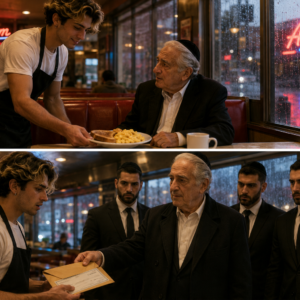
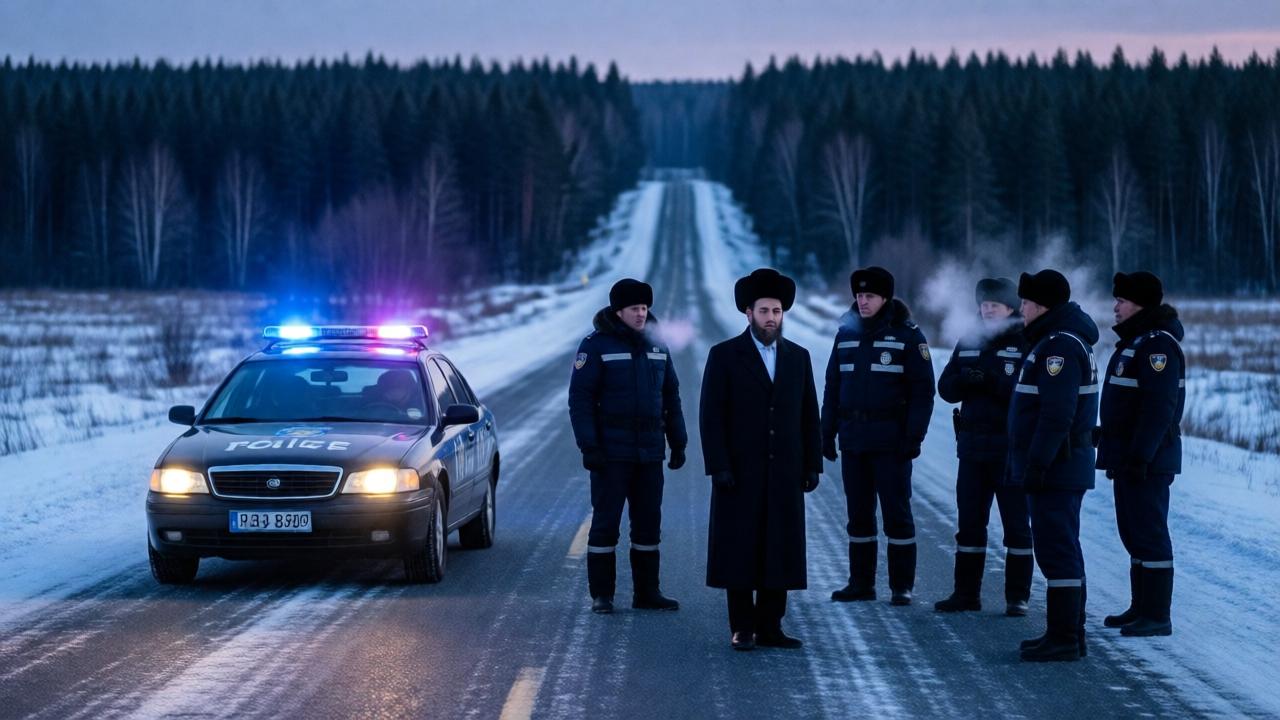
The winter steppe stretched endlessly under a bruised purple sky. On that frozen Friday evening, as dusk bled into night, the temperature plunged to minus 26 degrees Celsius. The air was so sharp and still that every sound seemed swallowed whole—until the distant hum of a patrol car shattered the silence. Flashing blue lights strobed across the icy asphalt, illuminating a sedan stopped dead in the middle of the road. Standing beside it, calm as a stone in a frozen river, was a young rabbi in a long dark coat and traditional hat, his neatly trimmed beard already dusted with frost.
Seven police officers surrounded him. Some blocked the road with their vehicles, others circled loosely, their breath turning to mist in the bitter cold. They watched, waited, uncertain. The rabbi—thirty years old, with European features and black leather dress shoes that seemed absurdly inadequate for the ice—stood with his hands at his sides. He looked cold, but his posture was resolute, as if anchored to something deeper than the frozen ground beneath him. The senior officer, a man of about thirty-five with short brown hair and blue eyes, stepped forward. His frustration was palpable. “Get in the car,” he ordered. “You’re blocking the road.”
The rabbi shook his head slowly. “I cannot get into a car. I cannot make a call. I cannot even take a receipt from you.” His voice was quiet but firm, carrying an unexpected warmth in the frozen air. “Shabbat has begun. For Jews, the day starts in the evening. It is a holy day of rest.” The officer stared at him, disbelief flickering across his face. “Today is Friday,” he said, a humorless laugh escaping his lips. “Every Saturday is Shabbat,” the rabbi replied. “Why are you messing with my head?” the officer snapped. “I’m going to take you to the station and confiscate your car.”
The rabbi did not flinch. “Of course, you can use force against me,” he said, his tone calm and measured. “But it will be considered persecution for religious reasons. I will have to take you to court, and I will definitely win the case. It will be a high-profile case, and you will have trouble. So it’s not worth it.” The officer’s jaw tightened. He glanced at his colleagues, who shifted uncomfortably in the snow. The tension was thick enough to cut with a knife—or perhaps with the dry humor that hung in the air like frost. “Well then? Any suggestions?” the officer asked, his voice edged with resignation.
- The rabbi proposed: “Tow the car away. I’ll walk home. The fines will be sent by mail; I will pay everything. But on Monday.”
- The officer scoffed: “You’ll walk? 20 kilometers at minus 26, in that coat?”
- The rabbi shrugged: “What can I do?”
- The officer offered an alternative: “I can move your car for you and cut your driving permit. Still cheaper than a tow truck. You just sit next to me. It will look like I hired you, and that is also work.”
The rabbi almost smiled. “But you can move the car voluntarily. And I can thank you later. But I will go on foot myself.” The officer shook his head, a grim smirk appearing beneath his mustache. “Great. And I will make sure the gratitude is sufficient. And on the way I’ll call an ambulance when your legs fall off in those shoes. Especially since you won’t have to wait long.” The rabbi met his gaze. “I know,” he said simply. A few of the younger officers began to mutter among themselves, their breath pluming in the cold. “I bet 5 that he won’t walk 10 kilometers,” one whispered. “I bet 5 he won’t make 5,” another replied, glancing at the thermometer on his patrol car. “It’s already minus 22. At most, I’ll make 5 kilometers. I’m timing it.”
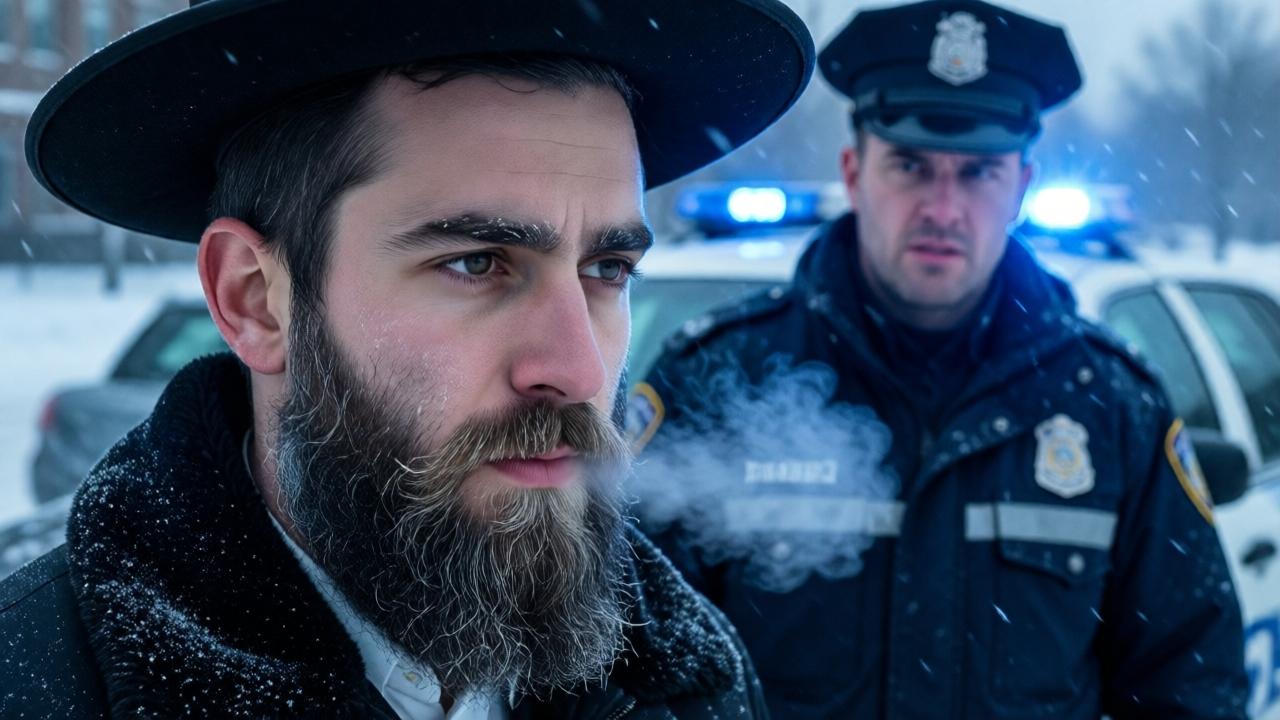
The officer turned back to the rabbi, his expression a mix of exasperation and grudging respect. “What, did you do nothing all day?” he asked. The rabbi’s eyes lit up with a quiet intensity. “The Lord worked in life, and on the seventh day He rested,” he said. “We Jews honor this day. Even Moses once asked Pharaoh for this day of rest when the Jews were slaves in Egypt.” The officer paused, then let out a long breath that turned to vapor. “Cool!” he said, surprising himself. The word hung in the frozen air, breaking the tension like a crack in ice.
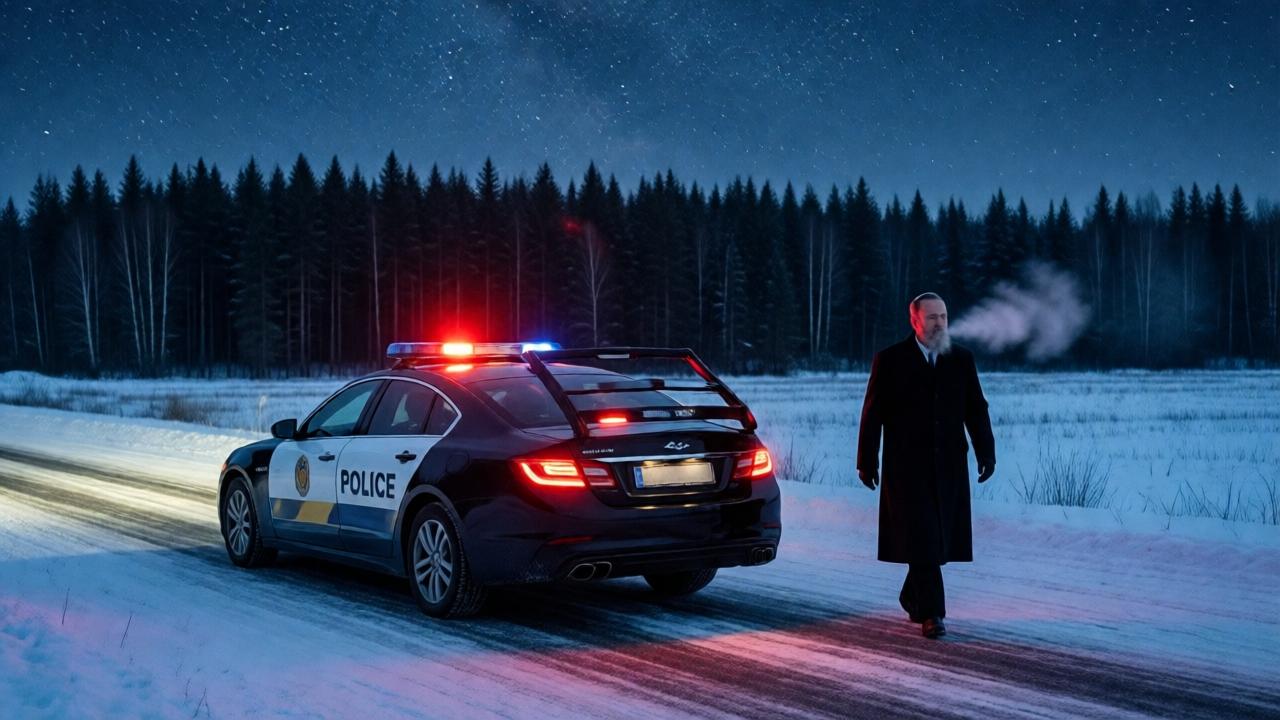
In the end, a compromise was reached. The officers towed the sedan to the nearest town, the rabbi walking alongside them for the first few kilometers before accepting a ride in a heated patrol car—on the condition that he would not be considered a passenger, but rather a pedestrian who happened to be traveling in the same direction. The fines would be paid on Monday, and the story would become legend in the local precinct. As the rabbi finally settled into the warm seat, he looked out at the frozen steppe and smiled. Sometimes, faith and the law find a way to walk the same road—even when that road is 20 kilometers long and the temperature is minus 26.