For Ethan, a 24-year-old college student in New York, exhaustion was a luxury he couldn’t afford. By day, he attended lectures; by night, he donned his delivery uniform, racing through the city’s streets. Every dollar was a lifeline for his mother and younger sister waiting at home. “If I make one less delivery,” he’d tell himself, “dinner gets a little smaller, the bills get a little louder.” So when a ping came through at 1 a.m. for a single burger to a wealthy neighborhood, he didn’t hesitate. The fee was negligible, but the principle was absolute: money was money.
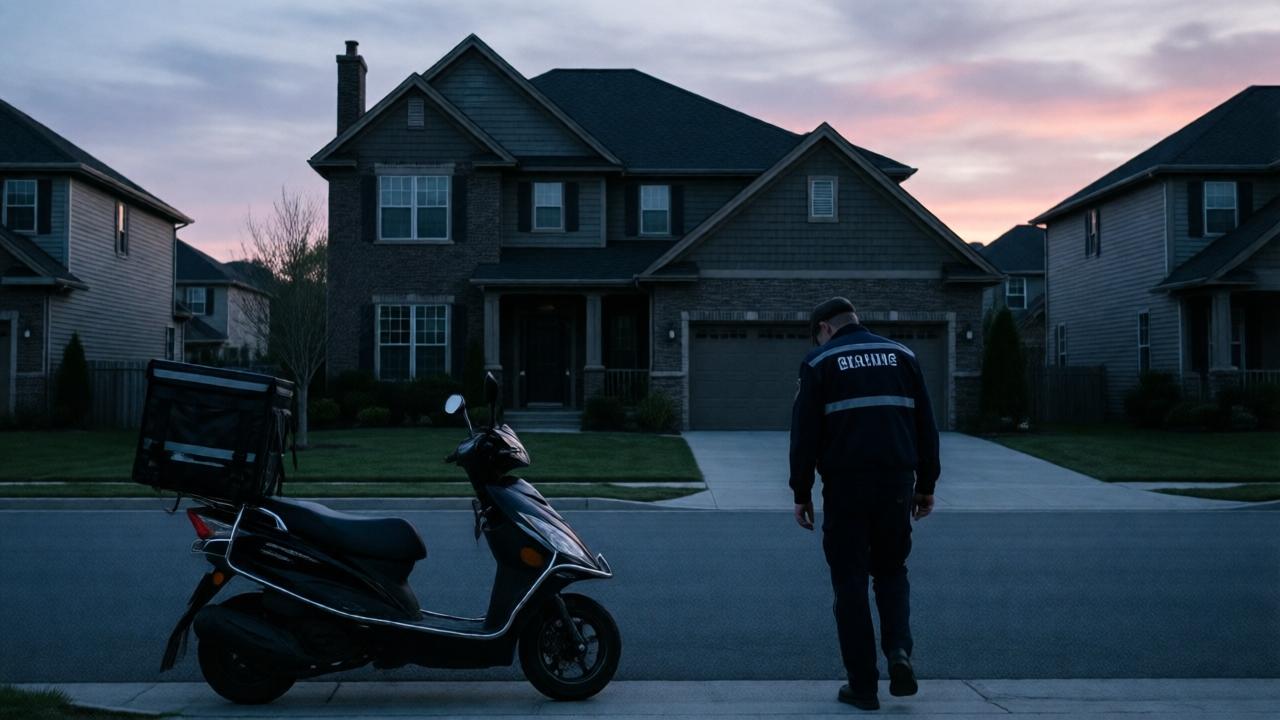
The destination was a sprawling, opulent house that seemed to swallow the night. Chloe, the customer who placed the order, answered the door with a casual smile. “Wait a second, I’m going to get the money,” she said, her voice light. “You can come inside if you want. It’s too cold out here. I’ll be right back.” Ethan, thinking only of courtesy and efficiency, stepped just over the threshold. Instantly, he was assaulted by a wall of sound—deafening music that vibrated the floorboards—and strobing lights that fractured the scene into jarring snapshots.
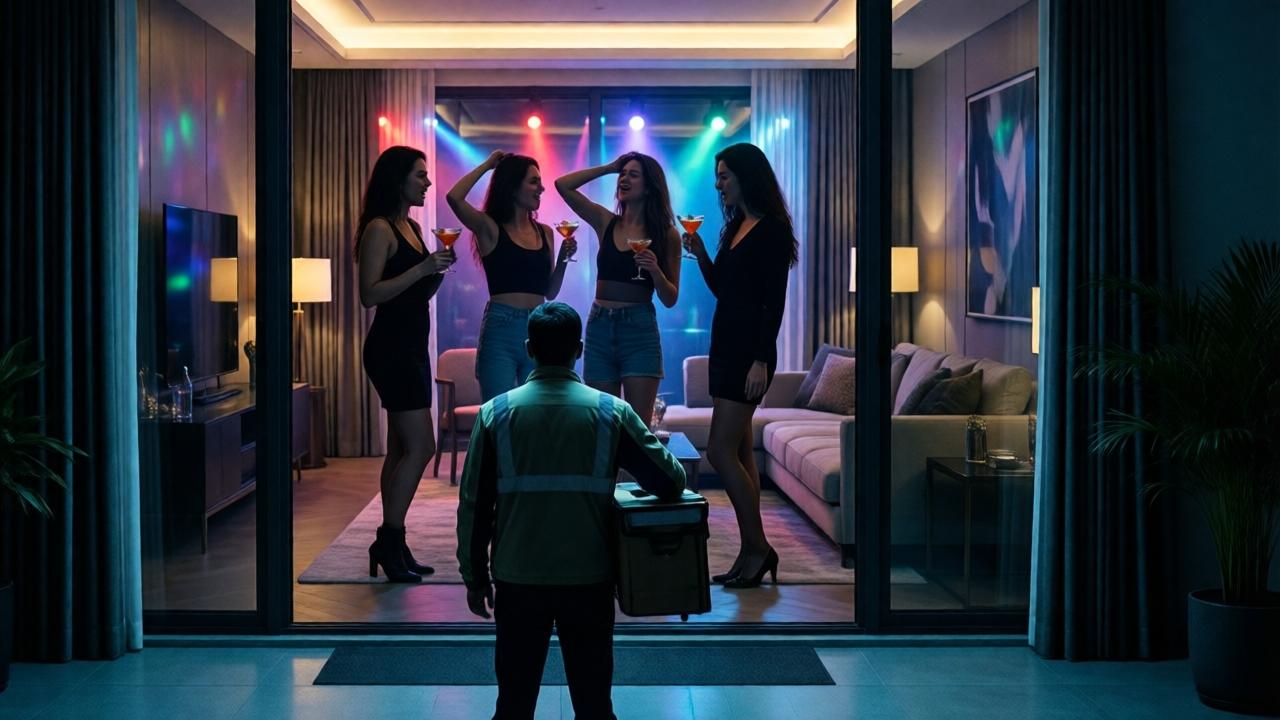
The air was thick with the cloying scents of alcohol and perfume. In the living room, four other girls, clearly inebriated, lounged with drinks in hand. Ethan kept his head down, posture polite, his only desire to complete the transaction and escape. But when Chloe returned, the friendly facade had vanished. She stepped uncomfortably close, her voice dropping to a venomous whisper. “If you leave right now,” she threatened, “I’ll call the police immediately and say you touched me.” In that moment, the world narrowed to a pinprick of dread. Ethan, a student just trying to get by, was frozen, trapped in a stranger’s home with no witnesses and a narrative being weaponized against him.
He tried to turn, to mumble an excuse, but it was too late. The other girls had already moved, forming a loose but effective circle around him, blocking the path to the only exit. Their laughter, which moments before seemed careless, now felt predatory. The dynamic had shifted from a late-night delivery to a captive audience. “I just want to go,” Ethan managed to say, but his words were swallowed by the pounding music. The fear was no longer just about a false accusation; it was about the immediate, physical reality of being outnumbered and detained.

What followed was a slow, agonizing ordeal of psychological torment and forced participation. He was paraded around, made the butt of jokes, and subjected to a humiliating loss of autonomy. The scariest part, as he later recounted, wasn’t the noise or their taunts. “The scariest part was that I desperately wanted to run, but realized I had absolutely nowhere to go,” he said. Every instinct screamed for escape, but the risk was too great. Who would believe his story? The optics were damning: a delivery guy in a wealthy home full of young women in the dead of night, claiming he was there against his will over a burger.
- The weaponization of a false accusation to ensure compliance.
- The exploitation of power dynamics—social, economic, and numerical.
- The terrifying vulnerability of service workers in isolated, private settings.
As the first hints of dawn greyed the windows, the party’s energy finally sputtered out. The girls, spent and distracted, eventually lost interest in their captive. Seizing a moment of inattention, Ethan finally slipped out the door, the cold morning air feeling like a baptism. He rode away on his scooter, the uneaten burger still in his thermal bag, a symbol of a transaction that had cost far more than its price. He never reported it. The burden of proof, he felt, was stacked against him. He simply went home, changed, and prepared for another day of class, carrying the silent weight of the night with him.
Ethan’s story is a chilling reminder of how quickly normalcy can unravel, and how the very systems meant to protect can be twisted into tools of entrapment. It underscores a hidden peril of the gig economy: the profound isolation and vulnerability of workers who enter private spaces, often alone, with little recourse when those spaces become hostile. His night of forced captivity wasn’t about a burger; it was about power, privilege, and the crushing realization that sometimes, there is no clean escape.