
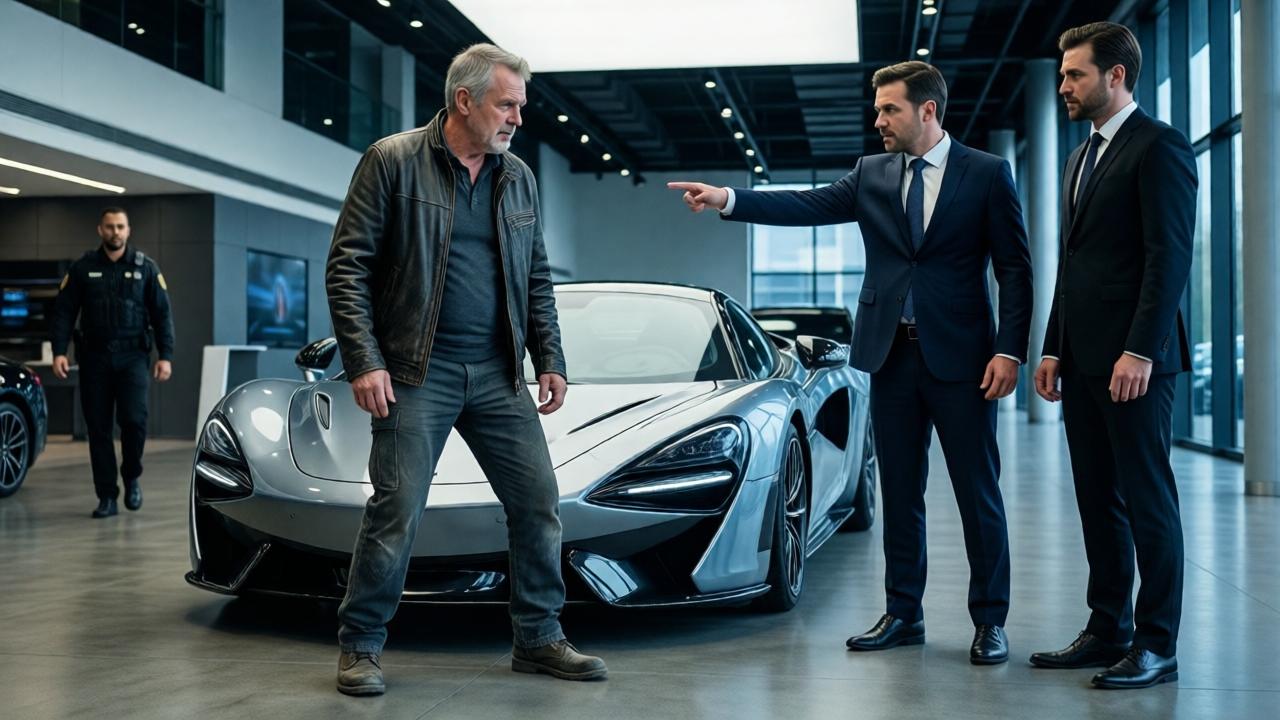
The question was simple, earnest. ‘Can I take this one for a test drive?’ I asked, my hand resting lightly on the gleaming hood of a hypercar that cost more than most houses. The salesman didn’t even look up from his phone at first. When he finally did, he squinted at me, his tone dripping with a sarcasm so thick you could spread it on toast. ‘Sir,’ he drawled, ‘this car costs more than your life savings. Please leave.’ My name is Frank. I’m 61 years old, and I had come in wearing my dusty work boots and a worn leather jacket—the same one I’ve had since I founded my company two decades ago. It was my uniform, a reminder of where I started. To him, it was just a costume of poverty.
The commotion drew the manager, a man whose suit was as sharp as his glare. He stormed over, looking at me like I was a stain on his pristine showroom floor. He didn’t just dismiss me; he dehumanized me. He spat near my scuffed boots and barked, ‘Don’t waste our time. You can’t afford to breathe near that car.’ On his signal, security began to move in. A snicker cut through the air from a corner. Someone else had their phone out, recording the spectacle for later laughs. For a long, suspended moment, I just stood there, my heart pounding not with anger, but with a profound sadness. I wondered, when did simple human respect become a luxury item with such an exorbitant price tag?
Then, I felt it—a light, hesitant touch on my arm. I turned to see a young woman, barely in her 20s, looking up at me with nervous, kind eyes. ‘Sir,’ she said softly, her voice almost a whisper against the manager’s bluster, ‘would you like some water? It’s free. We’re giving it out today.’ She hesitated, a quick, fearful glance darting toward her furious boss. ‘If you want,’ she continued, her courage visibly building, ‘I can still tell you about that car. You don’t have to buy it. Just… take a look.’ It was a tiny rebellion, a thread of decency in a tapestry of scorn.
The manager exploded. ‘Emma, are you out of your mind?’ he roared, his face flushing crimson. ‘Talk to him again, and you’re fired! Consider this your final warning.’ The young woman, Emma, flinched but held her ground for a second longer, her eyes apologetic. I nodded slowly, giving her the smallest, most genuine smile I could muster—a silent thank you that held volumes. I turned to leave, the eyes of the showroom burning into my back. But as I walked past her, I didn’t leave empty-handed. With a motion shielded from the watching crowd, I pressed a single, crisply folded business card into her palm.

The card was blank except for ten words, printed in a stark, elegant font: ‘Tomorrow, 10 AM, Greenwood Tower, top floor.’ No name, no title, no explanation. She stared at it, confusion etching her features, undoubtedly wondering if this was some bizarre joke. But tomorrow, she would learn who I really am. She would ride the private elevator to the penthouse suite of the city’s most iconic building and understand that the man in the dusty jacket was Frank Greenwood, founder and majority shareholder of the conglomerate that owned the very dealership that had just fired her. She would learn that her small, brave act of kindness—offering water and dignity to a stranger—was the only interview she ever needed.
- The power of presuming worth, not wealth.
- How a moment of empathy can alter destinies.
- Why the truest luxury is often basic human respect.
The manager thought he was protecting an asset. In reality, he was discarding the most valuable one in the room: character. Emma, with her free water and her willingness to see a person, not a price tag, had passed a test no corporate handbook could ever define. As I walked out into the sunlight, I knew the real engine of success wasn’t under the hood of that million-dollar car; it was in the heart of a young woman who dared to be kind when it was easier to be cruel. And tomorrow, that engine would get a new home, a new purpose, and a future she couldn’t yet imagine.

The manager thought he was protecting an asset. In reality, he was discarding the most valuable one in the room: character. Emma, with her free water and her willingness to see a person, not a price tag, had passed a test no corporate handbook could ever define. As I walked out into the sunlight, I knew the real engine of success wasn’t under the hood of that million-dollar car; it was in the heart of a young woman who dared to be kind when it was easier to be cruel. And tomorrow, that engine would get a new home, a new purpose, and a future she couldn’t yet imagine.