The funeral parlor had the kind of silence people trust too easily. Beige walls. Black clothes. A white coffin resting above polished floor. Mourners stood close together, trying to look dignified enough to survive grief in public. Among them was Marcus Vane, the lead mourner, a man whose black suit seemed to absorb the dim light like a second skin. His wife, Eleanor, had died suddenly three days ago—a heart attack, the doctors said. But as the maid named Rosa later confessed to me, something had felt wrong from the moment she saw the body.
“I worked at the Vane estate for ten years,” Rosa told me, her voice still trembling weeks after the incident. “Mrs. Vane was always kind to me. She had this way of looking at you like you mattered. And when I saw her in that coffin, her face was too pale—not the pale of death, but the pale of fear.” Rosa had noticed Eleanor’s fingers twitching during the viewing, but everyone dismissed it as a muscle spasm. “They said I was imagining things. But I knew. I knew she was alive.”
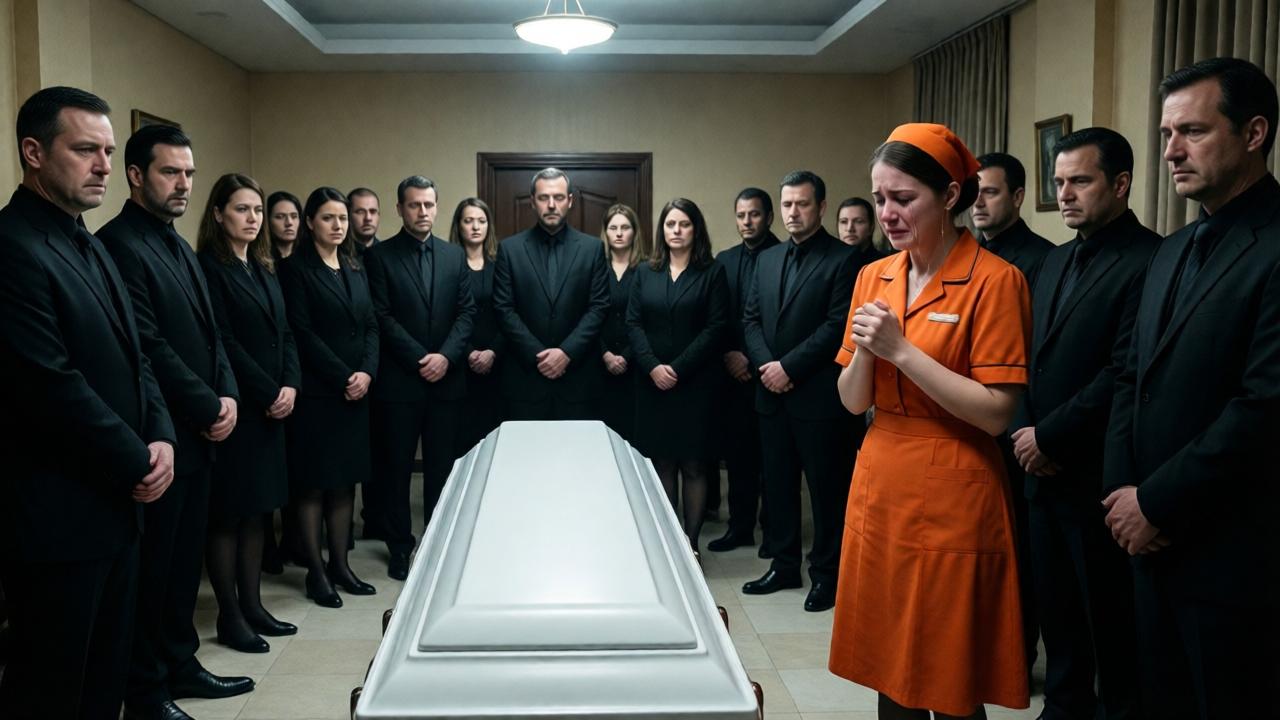
Then the maid screamed. Not politely. Not hysterically. Like someone who had run out of time. Before anyone could stop her, she swung the axe straight down into the coffin lid. The crack split the room open. White wood exploded. Women screamed. A man stumbled backward into another mourner. Someone dropped a black purse to the floor. The axe stayed buried in the lid for one second. Rosa’s chest heaved. Her orange uniform looked violent against all that funeral black. Then she shouted: “Stop! She’s not dead!”
No one moved. Because the sentence was too impossible to understand all at once. The lead mourner in a black suit stepped forward first, horrified. “What are you doing?!” Marcus Vane’s voice cracked, but his eyes held something else—something Rosa would later describe as “the panic of a man guarding a lie.” The maid yanked the axe free with both hands. Her face was wet with tears. Her hands shook so hard it looked like the weapon might fall from them. Instead, she pointed at the coffin. “I heard her.”
No one believed her. At least not yet. That was why the second blow landed even harder. The axe came down again. Another brutal crack. The lid split wider. Splinters flew. A woman in black covered her mouth and backed into the wall. Another started crying outright, not from grief now, but from fear. Rosa dropped to her knees beside the broken lid and shouted: “She’s breathing!” That was when Marcus rushed forward to stop her—and froze. Because from inside the coffin came a sound. Not loud. Not clear. Just enough. A scrape. A trapped breath. Something alive where nothing alive should have been.

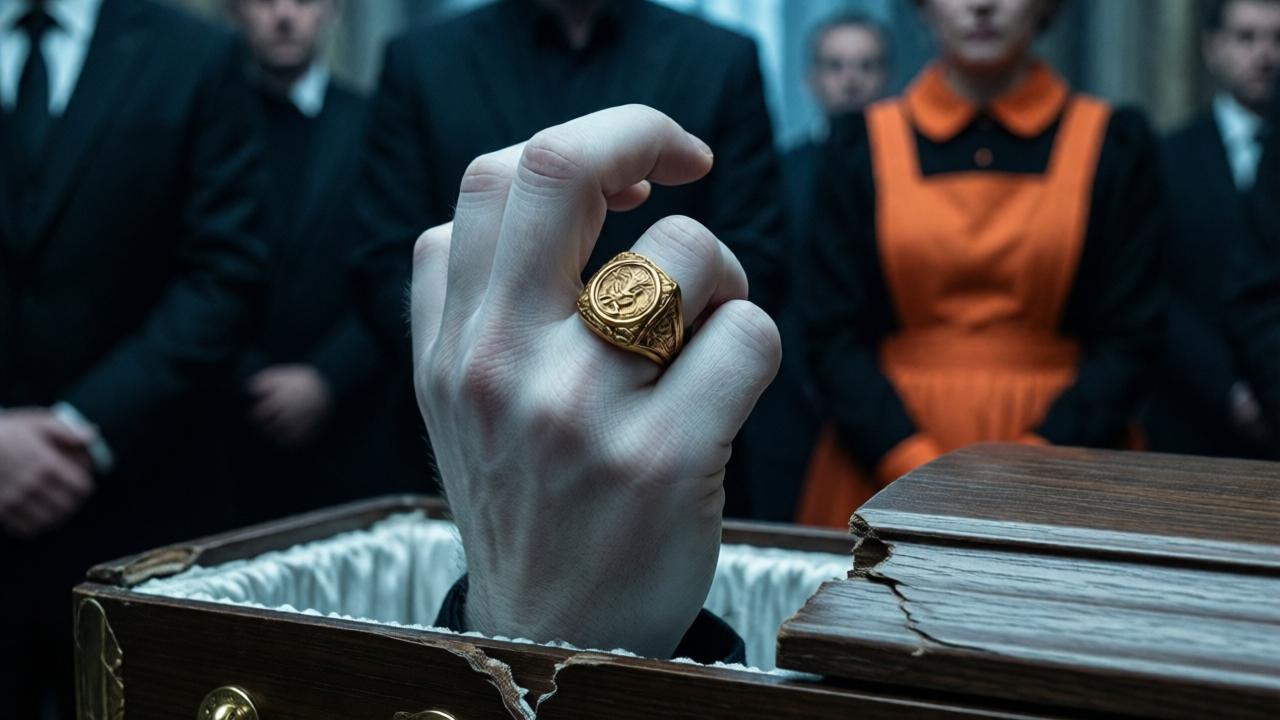
The whole room went dead silent. Rosa threw the axe aside and clawed at the broken lid with both hands. “Help me!” Marcus stared at the coffin like his own mind had betrayed him. His lips parted. “No…” Rosa pulled harder. Wood cracked again. And then, through the jagged opening—a hand inside twitched. The mourners gasped as one. Rosa looked up, shaking with horror and hope—and just as she reached to tear the lid open wider, she saw a gold ring on the hand inside. Not the dead woman’s ring. Marcus’s ring.
“I knew that ring,” Rosa said, her voice barely a whisper. “Mr. Vane wore it every day. It was his father’s. But there it was, on Mrs. Vane’s finger.” The truth unraveled in the following weeks: Marcus had drugged Eleanor with a paralytic agent, faked her death, and planned to bury her alive. The gold ring—a family heirloom—had slipped off his hand as he arranged her body in the coffin. “He was so confident no one would check,” the detective later told reporters. “He almost got away with it.”
Eleanor Vane survived. She spent three days in intensive care, recovering from the paralytic and the trauma. When she finally spoke, her first words were: “Rosa saved me. She was the only one who listened.” Marcus Vane was arrested at the hospital, still wearing his black suit. “I don’t understand how she knew,” he muttered to the police. “I planned everything.” But he had forgotten one thing: the ring. And he had forgotten that love, in its truest form, is not blind—it sees through coffins and lies.
The funeral parlor never reopened. But Rosa still works as a maid, now for Eleanor, who lives in a small cottage by the sea. “She calls me her angel,” Rosa said, laughing through tears. “But I’m just a woman who knew that silence can be a kind of violence. And sometimes, the only way to save someone is to break everything.” The gold ring? Eleanor keeps it on a chain around her neck. “As a reminder,” she says, “that even in the darkest coffin, there is a hand reaching for light.”