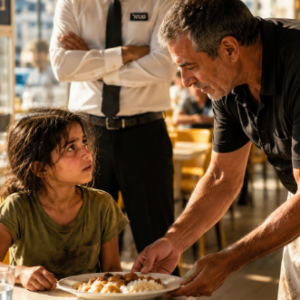
In the small town of Millfield, there was an unspoken rule: no one went into the old Harmon stable. Not the farmers, not the children, not even the veterinarians who had been called twice and were both sent away by the man who owned the stable—a large, broad-shouldered man named Roy Harmon, who smelled of cheap whiskey and even cheaper anger. But rules, as Clara would discover, are only as strong as the courage it takes to break them.
Clara was nine years old, small for her age, with long dark hair her grandmother braided every morning and which always came half undone by noon. She had a habit of collecting things—feathers, smooth stones, bits of colored glass—and keeping them in a tin box under her bed. She also had a habit of going places she wasn’t supposed to go. And she heard the horse. For three weeks, at night, when the town grew quiet and the only sounds were crickets and the distant highway, she would lie in bed and hear it—a soft, broken sound that was neither a whinny nor a cry, but something in between. A sound that made her chest ache in a way she didn’t yet have words for.
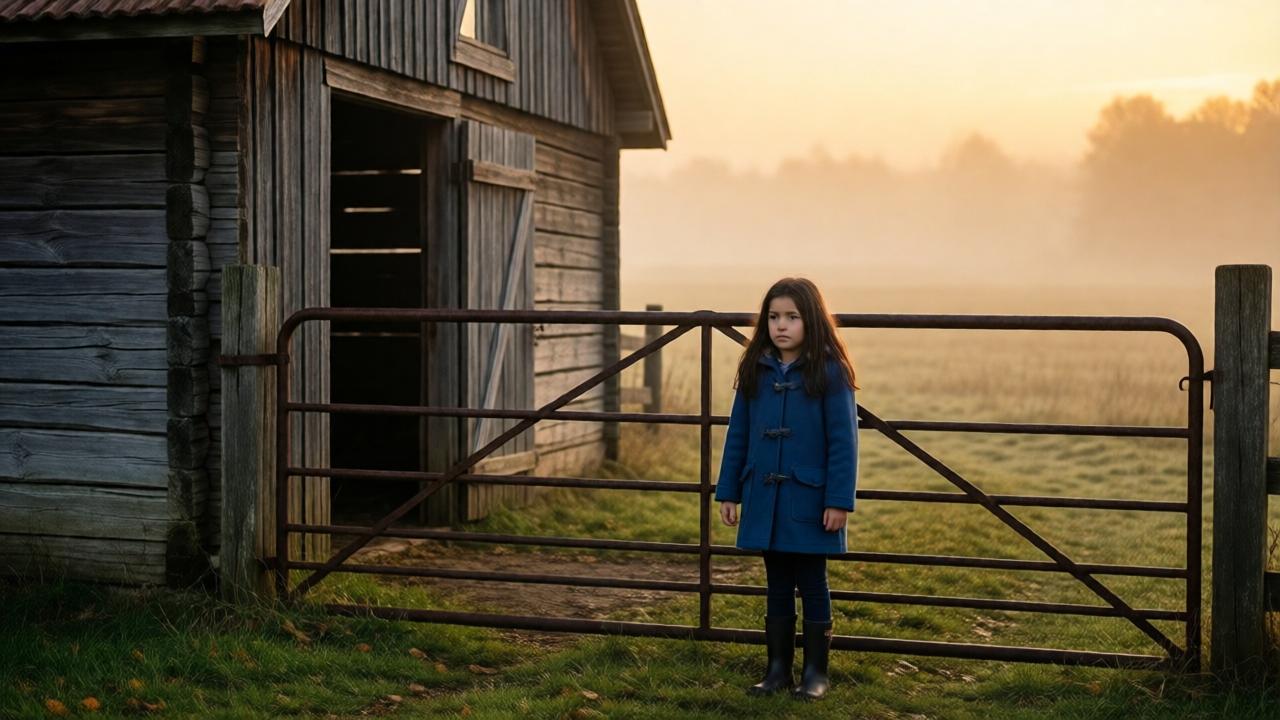
She asked her grandmother about it. Her grandmother’s face did something complicated. “That’s Roy Harmon’s horse,” she finally said. “Don’t go near that stable, Clara.” “Why?” “Because Roy Harmon is not a kind man.” Clara thought about that for three more weeks. Then she went anyway. She went on a Tuesday morning in early October, when the fog still hung low over the fields and the light was the color of old honey. She wore her boots and her blue coat and carried nothing except the particular quiet courage that belongs only to children who have fully made up their minds.
The stable stood at the edge of the Harmon property, hidden from the road behind rusted iron gates. The wood was gray and cracked. The smell reached her before she opened the gate—something sharp and sad and old. She opened it anyway. Inside, in the far corner, stood the horse. It was large—chestnut-colored, with a darker mane tangled and neglected. Its ribs showed. Its head hung low. Around its neck and muzzle was a rope halter pulled so tight that in two places it had rubbed the skin raw and bloody. It stood completely still—the way animals stand when they have learned that movement brings pain.
Clara stopped. She stood two steps away and looked at it for a long time. Then she raised one small open hand. The horse did not move. It did not flinch. It did not step forward. It simply stared at her hand with very dark, very deep, very tired eyes—eyes that had seen enough human hands to have formed a firm opinion about them. Clara kept her hand raised. She did not speak. She did not move. She simply waited—the way her grandmother had taught her real patience worked—not as the absence of wanting, but as the willingness to let something happen in its own time. It took four minutes. She counted. Then the horse lowered its great head, slowly, inch by inch, and touched its nose to her palm. Its breath was warm. Its nose was impossibly soft.
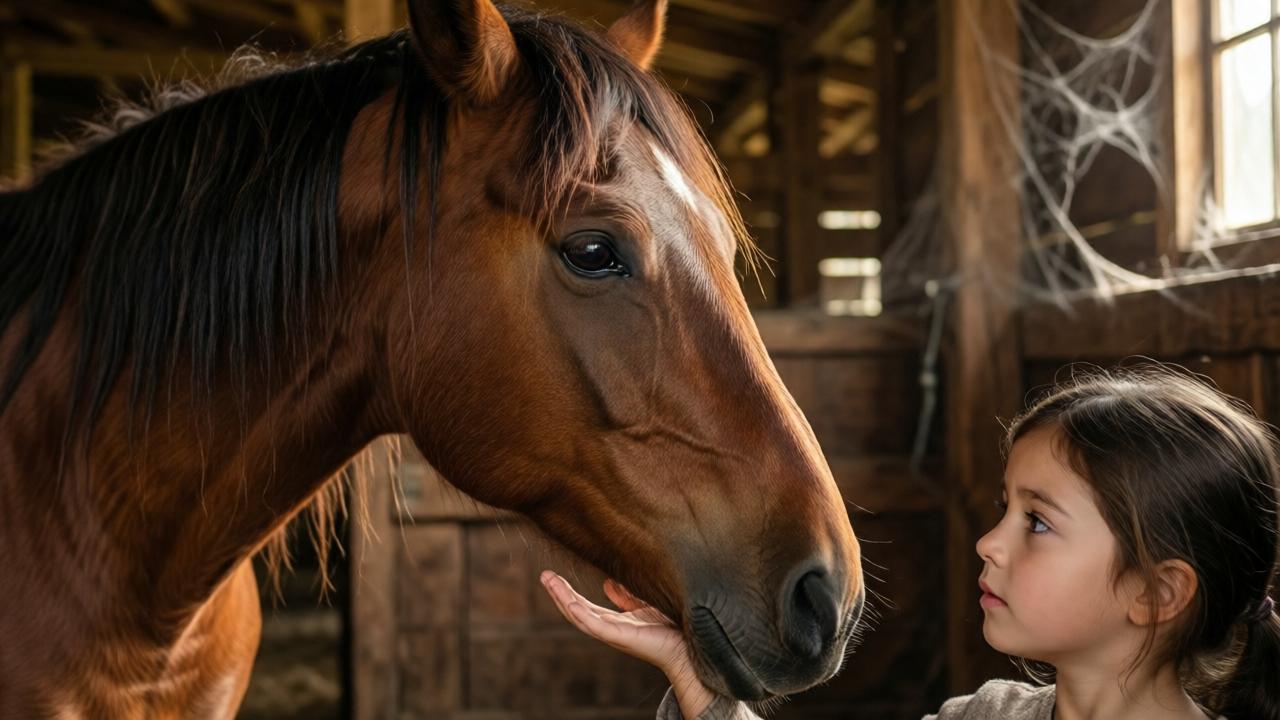
Clara felt something shift inside her chest—something clenched loosened—and she didn’t fully understand it, but she understood enough. “Hi,” she whispered. “I heard you.” She was already reaching for the halter when Roy Harmon appeared in the doorway. She heard him before she saw him—the heavy slam of his palm against the doorframe, a sound that seemed to shake the entire stable. “GET AWAY FROM HIM!” he shouted, his voice cracked with something that was anger, and beneath the anger panic, and beneath the panic something else entirely, something Clara did not yet have a name for. “HE’LL KILL YOU! GET AWAY!”
Clara turned and looked at him. She looked at his red face and his wide furious eyes and his hands gripping the doorway so tightly his knuckles had gone white. Then she turned back to the horse. And unfastened the halter. It took both hands and some time, and Roy Harmon kept shouting, but Clara kept her hands steady and her breathing even and thought of nothing except the two bloody spots on the horse’s skin, and what its eyes had looked like when she raised her hand, and the four minutes of waiting that had ended with warm breath against her palm. The buckle gave way. The halter loosened. She slowly, carefully lifted it off the horse’s head and let it fall from her hands. It hit the damp floor with a heavy sound.
Roy Harmon fell completely silent. The horse stood very still. It stood that way for a long moment, as if it still did not trust the absence of pressure, as if it expected the restraint to return, because restraint had always returned before. Then, slowly, its head lowered. And it rested it on Clara’s small shoulder. Its weight was enormous and gentle at the same time. Clara swayed slightly but stayed standing, wrapping her arms around its muzzle as far as she could, which was not very far, which did not matter. She felt its breathing slow. She felt the trembling in its muscles—years, she thought, years of fear—gradually, gradually easing. And then she cried.
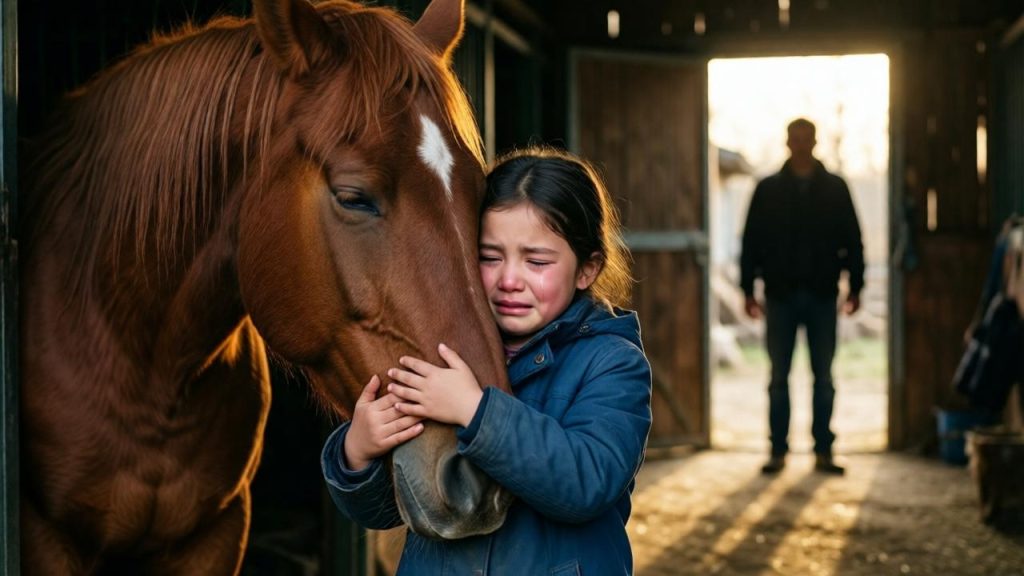
She had not planned to cry. She did not fully understand why she was crying. But the tears came anyway, quiet and steady, and she let them, because some things deserve tears, and this was one of them. She looked up at the horse. “You’re safe,” she whispered. “Nobody’s going to hurt you anymore.” Roy Harmon had not moved from the doorway. Clara looked at him over the lowered head of the horse. He was no longer shouting. He stood very still, and his face had changed completely—the rage gone, replaced by something raw and old and almost unrecognizable. His eyes were wet.
Clara looked at him for a long time. “When was the last time someone took something off of you?” she asked. She was nine years old. She did not fully understand what she meant by the question. But Roy Harmon’s face crumpled when she asked it, and he turned away, and his shoulders jerked once, and then he walked across the field and did not come back for a long time. The horse did not have a registered name. When Roy Harmon was asked, he said he had never given it one. Names, he said, were for animals you planned to keep. Clara named her Tuesday. Because Tuesday was the day she let Clara touch her. The day the halter came off. The day her breathing slowed and her eyes changed and something that had been closed for a very long time opened just a little.
- Clara visited Tuesday every day after school, bringing apples and soft words.
- On the third day, her grandmother came and stood in the stable doorway, watching in silence before saying, ‘I’m going to make some calls.’
- Six weeks later, Tuesday was transferred to a proper facility with a paddock, good hay, and a veterinarian who quietly said he had seen many horses, but few that had carried so much for so long.
Roy Harmon did not resist the transfer. He stood by the gate watching the trailer drive away and said nothing. Clara stood beside him. After a long time, she placed her small hand on his hand. “You should find someone to talk to,” she said. “The way I talked to Tuesday.” Roy Harmon looked at the empty road where the trailer had disappeared. “Maybe,” he said. It was not yes. But it was not no, either. And sometimes, Clara realized, that is where everything begins.