
Linda had always believed she was a master of her own fate. She married Michael, a wealthy businessman in a remote Georgia town, and together they built a life that others envied. But one shadow lingered: they could not have children. After years of trying, they adopted a sweet orphan girl named Emma, hoping she would fill the void. For a year, the house felt complete. Then, miraculously, Linda gave birth to twin daughters, Sophie and Chloe. What should have been a blessing became a curse for Emma. From that day on, Linda’s heart hardened, and Emma’s place in the family crumbled.
Emma was no longer a daughter but a servant. She was banned from sitting at the dinner table, forced to eat scraps in the kitchen. Her days were filled with scrubbing floors, washing dishes, and tending to the twins’ every whim. “You’re not one of us,” Linda would whisper when Michael wasn’t listening. “You were just picked up from the street.” The twins, spoiled and cruel, took after their mother, mocking Emma’s plain clothes and dirty hands. Only Michael, Emma’s adoptive father, saw her true worth. He often said, “Emma brought luck into this house. She’s our angel.” But when Emma turned sixteen, Michael died suddenly, leaving her without her only protector.

After Michael’s death, Linda’s cruelty knew no bounds. She saw Emma as a burden, a reminder of a time when her family was incomplete. One evening, Linda announced a plan that shocked even her own daughters. “Emma is old enough to marry,” she declared, her voice dripping with malice. “I’ve found a suitable match for her.” The “match” was a beggar Linda had spotted on the street—a man in tattered clothes, with a scraggly beard and hollow eyes. Linda laughed as she described him. “He has nothing. He’s perfect for her.” Emma begged, but Linda was unmoved. “You’ll leave tomorrow. No arguments.”
The wedding was a farce. Emma stood in a ragged dress, her eyes swollen from crying, while the beggar, who introduced himself only as Jack, stood beside her. He smelled of rain and dirt, and his hands were calloused. Linda smirked from the front row, whispering to her twins, “See? That’s where she belongs.” But as Jack looked at Emma, there was a flicker of something—kindness, perhaps, or recognition. He took her hand gently and said, “Don’t be afraid. I know this isn’t what you wanted.” Emma felt a strange calm, as if the storm inside her had paused.
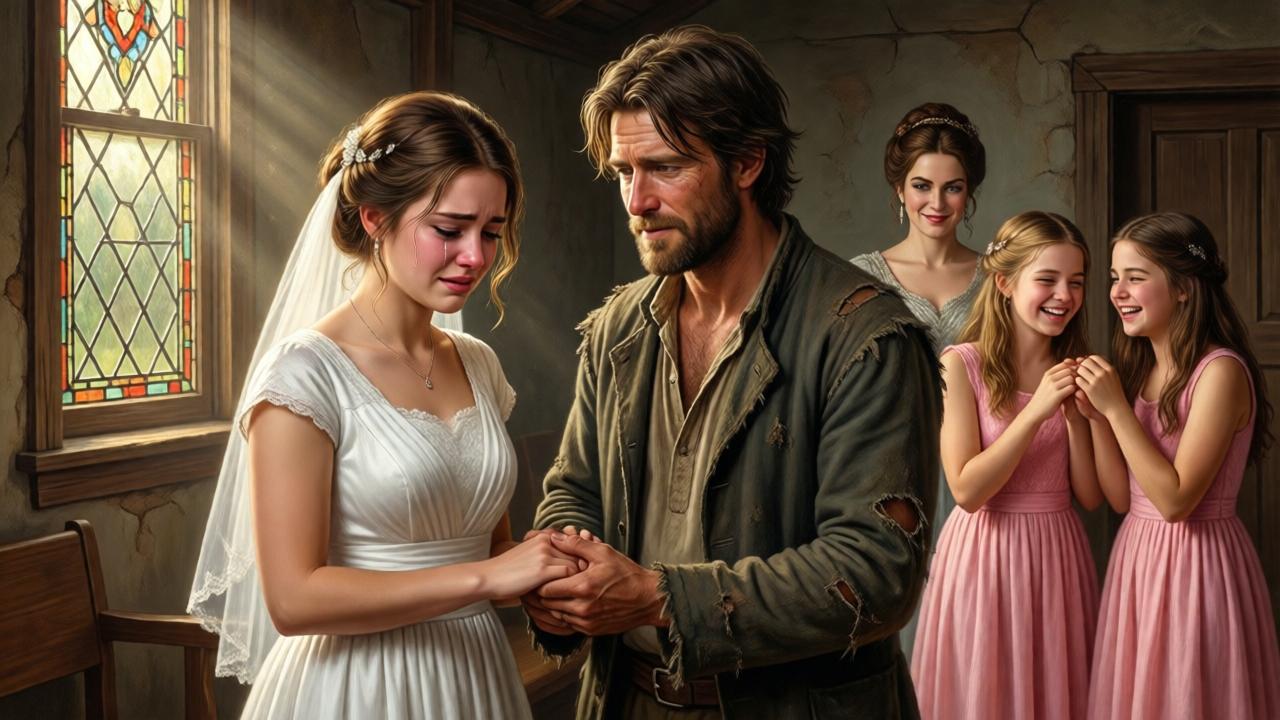
After the ceremony, Jack led Emma to a small, run-down cabin on the outskirts of town. It was humble, with a leaky roof and creaky floorboards, but Jack treated her with a respect she had forgotten existed. He cooked simple meals, mended her torn dress, and listened to her stories without judgment. One night, as they sat by a crackling fire, Jack revealed his truth. “I’m not a beggar, Emma,” he said, his voice low. “My name is Jack Harrington. My family owns half the land in this state. I’ve been hiding, testing people’s hearts. But you—you’ve shown me kindness without expecting anything.” Emma’s breath caught. “Then why did you let my mother marry us?” Jack smiled. “Because I saw you. And I knew you deserved better.”
Weeks passed, and Jack’s transformation began. He shaved his beard, bought new clothes, and made calls to his family’s estate. Soon, a black car arrived at the cabin, driven by a man in a suit. “It’s time,” Jack said, holding Emma’s hand. They drove back to Linda’s house, where the woman was tending to her garden. When she saw Jack step out, clean-shaven and dressed in fine silk, her jaw dropped. “What… what is this?” she stammered. Jack walked up to her, his voice calm but firm. “I am the heir to the Harrington fortune. You married your daughter to a beggar, but you gave her to a king. And I intend to give her everything you denied her.”

Linda’s world shattered. She had tried to ruin Emma’s life, but instead, she had handed her a fortune. The twins, Sophie and Chloe, stared from the window, their faces pale with envy. Jack turned to Emma and said, “What do you want to do? We can walk away. We can leave them with nothing.” Emma looked at Linda, who was now trembling, tears streaming down her face. “I don’t want revenge,” Emma said softly. “I just want to be free.” Jack nodded. “Then we’ll go. But first, let me show this town what happens when you try to break someone like Emma.” He pulled out a document—a deed to Linda’s house, which he had bought through a shell company. “You have one week to leave,” he said. “This house is now Emma’s.”
Emma and Jack built a new life together, far from the small town. They traveled, opened a foundation for orphans, and never looked back. Linda and her daughters were forced to move into a small apartment, working menial jobs for the first time in their lives. The town whispered about the beggar who turned out to be a prince, and the girl who rose from ashes. Emma often thought of Michael, the father who had believed in her. “He would have been proud,” she told Jack one evening, as they watched the sunset over their estate. Jack squeezed her hand. “He is proud, Emma. And so am I.”