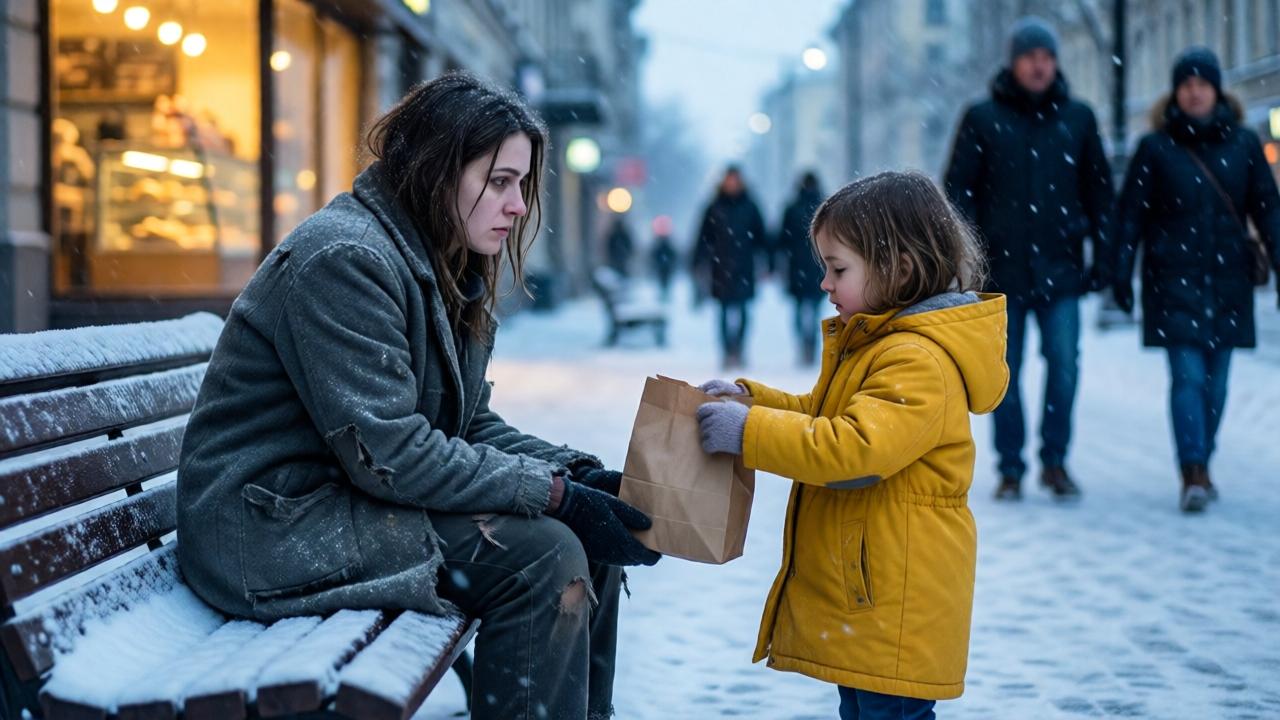
The snow fell like a quiet secret over the city streets, muffling the sounds of hurried footsteps and distant traffic. People pulled their coats tighter and averted their eyes from the young woman huddled on the bench. Her torn gray clothes clung to her thin frame, and her bare feet—purple with cold—pressed against the frozen ground. She looked like winter had already taken too much from her. Her hands, so cold they barely seemed alive, rested limply in her lap. Her eyes, too tired to ask anyone for anything, stared at nothing in particular.
Then a splash of color broke the gray monotony. A little girl in a bright yellow coat stopped directly in front of the bench. She held out a small brown paper bag with both mittened hands, her breath forming tiny clouds in the icy air. “Are you cold?” she asked, her voice soft but clear. The woman looked up slowly, surprised by the voice, surprised by the face, surprised that anyone had chosen her out of all the moving strangers. “A little,” she said softly. “But I’m fine.” The child nodded as if she understood something deeper than the words. “This is for you. Daddy bought them for me. But you look hungry.” Inside the bag were still-warm pastries from the bakery across the street. The woman took it with shaking fingers. “Thank you.”
That should have been the end of it. A small act of kindness. A winter moment. A hungry stranger. A child with a good heart. But the girl didn’t move. She just stood there, looking directly into the woman’s face, studying her the way children do when they are not guessing—when they are remembering. Her head tilted slightly, her eyes narrowing with a strange recognition. The woman felt a chill that had nothing to do with the cold. Then the little girl spoke again, and the sentence made the woman stop breathing. “You need a home, and I need a mom.”
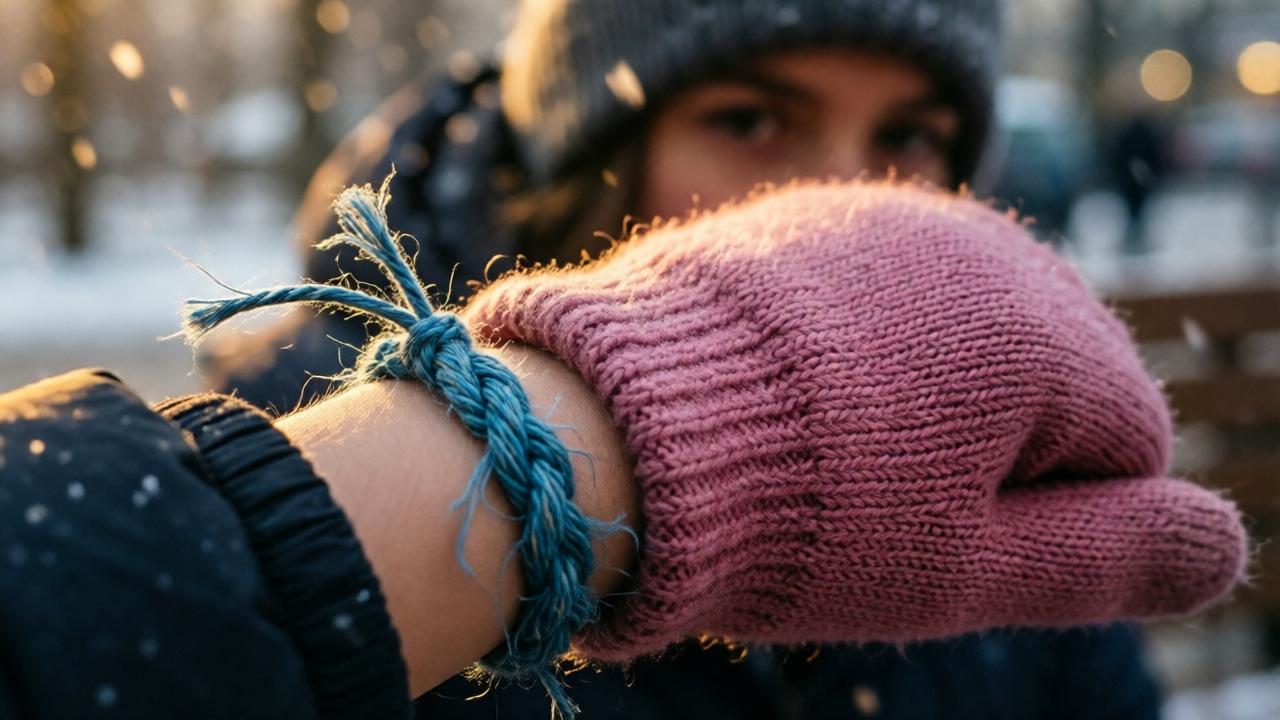
The woman’s heart hammered against her ribs. “What?” she managed to whisper. The little girl’s eyes filled with sudden hope, a light that seemed to warm the falling snow around her. “My daddy says moms can go away and still come back if God wants them to.” The young woman’s hands began to tremble around the paper bag. Because tied around the child’s wrist, half-hidden under her glove, was a faded blue thread bracelet. The exact kind she used to braid years ago when she was pregnant. The kind she made only one of. Her breath caught in her throat. She remembered the night she tied that bracelet around her own wrist, promising her unborn child that she would always be connected to them, no matter what.
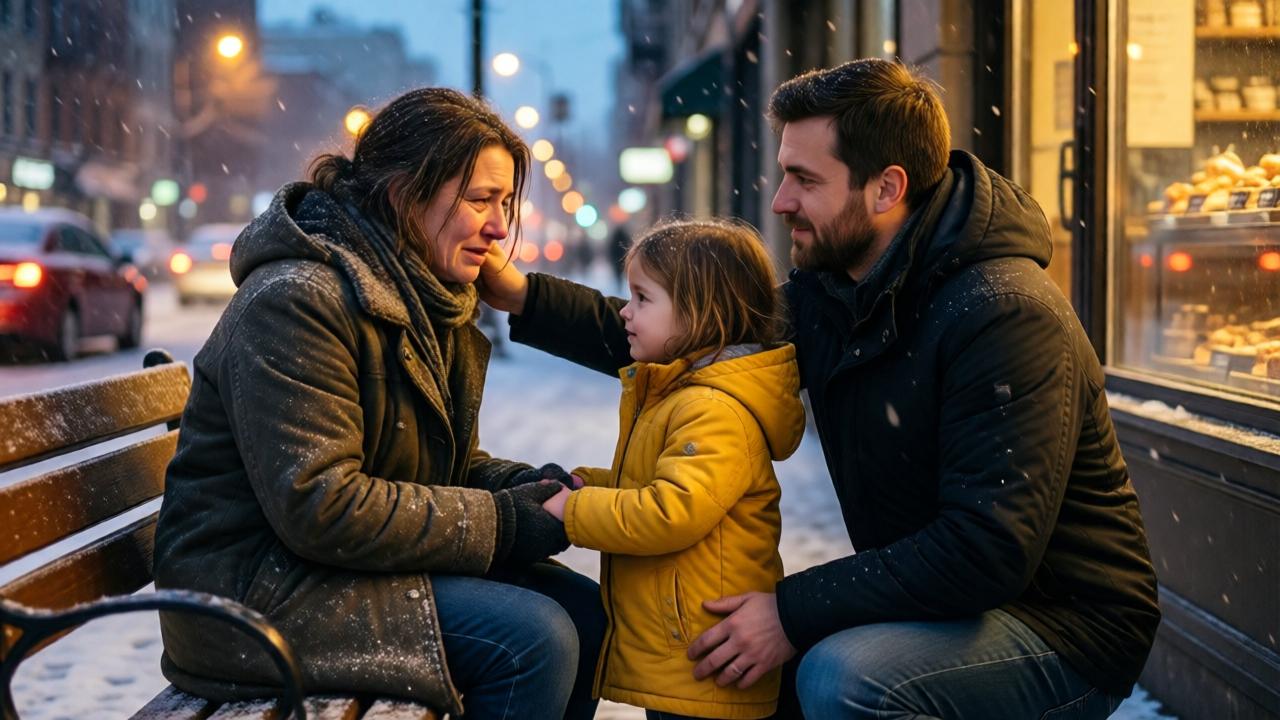
Then the man in the distance finally stepped closer through the snow. He had been watching from across the street, his hands shoved deep into his coat pockets, his face a mask of uncertainty. But when the little girl didn’t return, he began to walk. The woman looked up at his face as he approached—and the paper bag slipped from her hands. Pastries scattered on the snow. Because she knew him. He was the man who had been told she died the night their baby was born. His name was Daniel, and she had loved him with a fierceness that had almost destroyed her.
The story had begun six years earlier, in a small apartment on the other side of the city. Sarah—that was her name—had been young and terrified, alone in a world that had never been kind to her. When she went into labor, complications arose. She remembered the blood, the screaming, the white lights. Then she remembered nothing. Daniel had been told she didn’t make it. But she had woken up in a different hospital, with no identification, no memory of who she was. Months of confusion followed, then years of drifting. She had wandered, lost, until she ended up on this bench, in this snow, on this night.
- The blue thread bracelet she had made while pregnant, a symbol of her promise to her child.
- The pastries from the bakery, bought by Daniel for his daughter every Saturday morning.
- The yellow coat, chosen by the little girl herself because it reminded her of sunshine.
- The snow, falling softly as if the world itself was holding its breath.
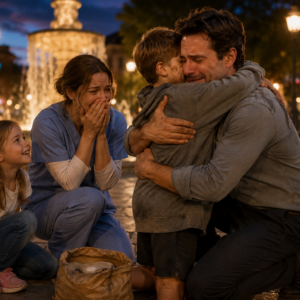
Daniel knelt down in the snow, his face pale, his eyes wide with disbelief. “Sarah?” he whispered, his voice cracking. The little girl looked from her father to the woman on the bench, her hope growing. “I told you, Daddy,” she said softly. “I told you she would come back.” Sarah reached out a trembling hand and touched the blue thread on her daughter’s wrist. Tears streamed down her face, warm against the cold. “I never forgot,” she said. “I never forgot you. Not for one second.” Daniel took her other hand, and for a long moment, the three of them stayed there in the snow, a family reunited by a child’s faith and a faded piece of thread.
Later, as they walked toward Daniel’s car, the little girl held Sarah’s hand tightly. “I knew it was you,” she said, her voice filled with certainty. “How?” Sarah asked, still trembling. The girl shrugged. “Your eyes. They looked like mine in the mirror. And the bracelet. I wore it every day because Daddy said it was from my mom. I never took it off.” Sarah squeezed her daughter’s hand, feeling the thin threads press against her palm. She had made that bracelet with love and fear, never knowing if she would ever see the child she carried. Now, that same bracelet had led her home.
The snow continued to fall, but it no longer felt cold. Sarah looked back at the bench one last time, then at Daniel and their daughter. She didn’t know what the future held—years of lost time, healing, and rebuilding—but for the first time in six years, she felt warm. Because sometimes, kindness isn’t just kindness. Sometimes, a child with a pastry and a faded blue thread can find the mother the world thought was gone forever. And sometimes, the snow falls not to bury us, but to bring us back to the people we never stopped loving.