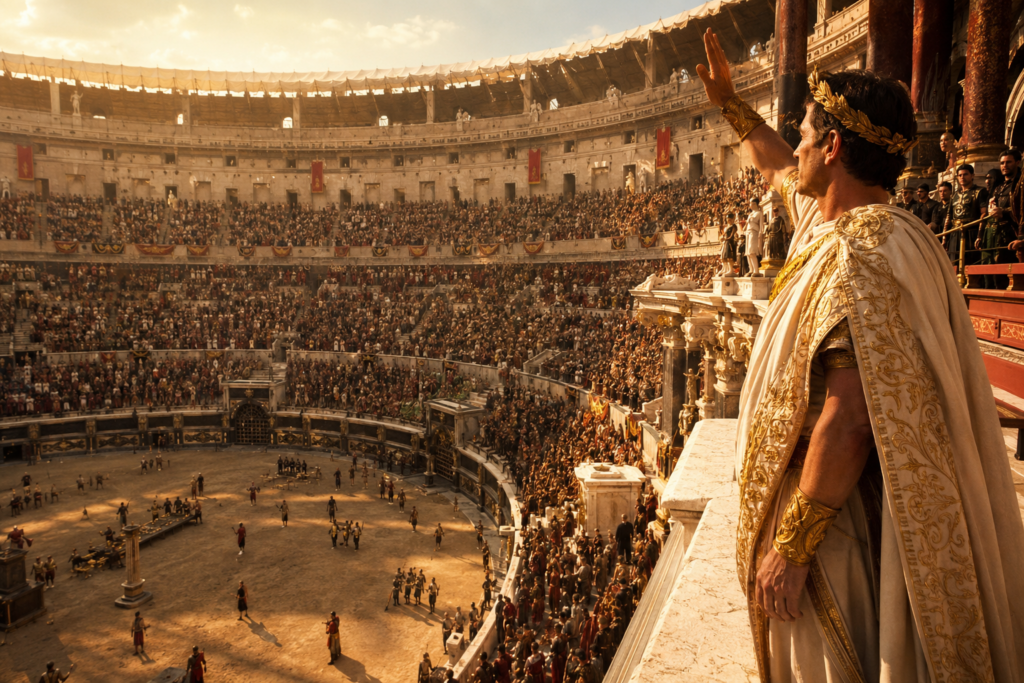
The sun blazed down on the Colosseum like a golden hammer, turning the sand of the arena into a sea of shimmering heat. Dust hung in the air, thick and gritty, carried by the roars of fifty thousand spectators packed into the towering stands. It was a day of spectacle, of blood, and of judgment—a day when the fate of a single boy would be decided by the whim of the crowd and the claws of a beast.
High above the arena, on a balcony carved from white stone and painted with scenes of Roman glory, the Supreme Ruler rose from his throne. A man of forty-five years, with silver-streaked hair and a crown of gold upon his head, he wore a flowing white mantle embroidered with threads of gold. He placed his hands on the ornate railing and raised his right arm, signaling the start of the event. The crowd fell silent, then erupted into a frenzy of cheers.
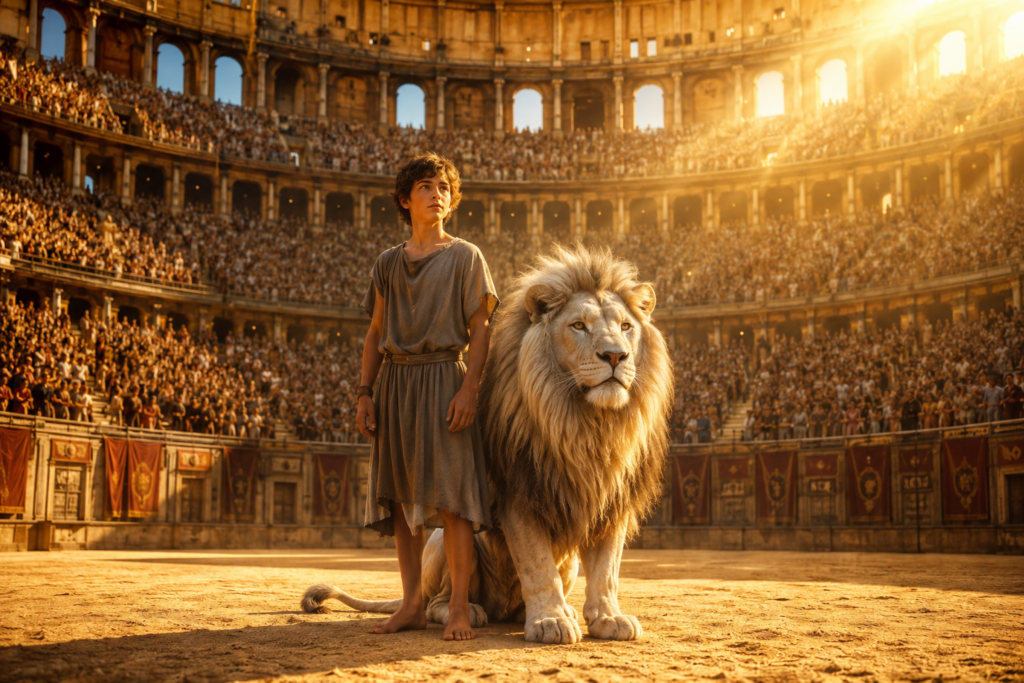
In the center of the arena stood a boy, no more than eight years old. He was a Slav, with messy brown hair and eyes that held more fear than any child should know. His clothes were gray rags, torn and dirty, the mark of a low caste. Before him, a heavy iron grate in the sand floor slid open with a grinding screech. From the darkness below came a low, rumbling growl.
Then the lion emerged. It was an old beast, its once-pure white coat now yellowed and scarred. Deep gashes ran across its flanks and muzzle, trophies of countless battles. It blinked in the harsh sunlight, then fixed its amber eyes on the boy. The crowd held its breath. The lion lowered its head, muscles coiling, ready to spring.
- The boy’s father was a gladiator who once fought alongside the lion.
- The lion was injured and the father nursed it back to health.
- They formed an unbreakable bond, but were separated when the father was sold to another arena.
- The boy carried the clay tablet as his only memory of his father.
But the boy did not run. He reached into his tattered tunic and pulled out a small clay tablet, no larger than his hand. On it was a crude carving: a lion standing on its hind legs, its front paws resting on the shoulders of a warrior. The boy held it up, his hand trembling, and spoke in a voice that cracked with emotion: “Please, look at me!”
The lion stopped. Its ears flicked forward. The boy took a step closer, his voice growing steadier. “My dad said you’d know this!” He pointed at the tablet, tears streaming down his dusty cheeks. “He told me about you. He said you were his friend. He said you saved his life in the arena, and that you were the bravest lion in all of Rome.”
With a sudden, powerful movement, the lion reared up on its hind legs, the boy clinging to its back. The crowd gasped. The Supreme Ruler leaned forward, his face a mask of disbelief. The lion let out a deep roar, then turned and leaped into the open pit from which it had emerged, carrying the boy into the darkness below.
The Supreme Ruler slammed his fist on the railing. “Guards behind them!” he shouted, his voice cutting through the chaos. But as the guards scrambled to follow, the ground trembled, and a section of the arena wall collapsed, sealing the passage. The boy and the lion were gone, vanished into the labyrinth beneath Rome.
In the days that followed, the story spread across the empire: a boy who spoke to a lion, and a lion who remembered a gladiator’s kindness. Some said it was a miracle. Others called it a trick. But the boy and the lion were never found. They became a legend, whispered in the shadows of the Colosseum, a reminder that even in the heart of cruelty, love and memory can carve a path to freedom.